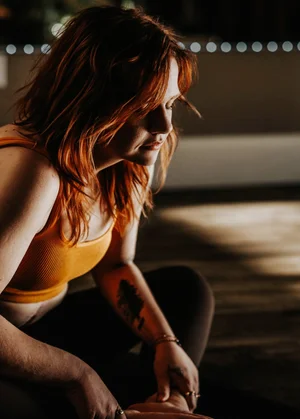
somatic poetry from a body on the brink
There’s this unspoken knowledge that women in the late stages of pregnancy can be more emotionally volatile because they’re hard at work growing a baby. I feel the same way whenever August rolls around, but it’s because I’m hard at work incubating a story.
A story the world knows one version of - the flashy, headline worthy version - and that I know a different version of - the quiet grief of life becoming death becoming life again.
Little things where I would normally roll with the punches are setting me off in ways that don’t make a ton of rational sense. My physical body feels stiff with old memory. If I could, I would probably walk around with a handle with care sign taped to my forehead.
It’s August, and 6 years ago I left this month an entirely different person than when I entered it.
And it’s been 6 years, shouldn’t I have found some way to incorporate the grief into my life by now? I’m alive, right? Surviving, breathing, by all quantifiable metrics a successful transplant story. And I am. I feel the need to add in that clause every time I talk about my transplant story, because people on the internet say cruel things when they deem you not grateful enough for your own life. It’s 2026; grief and gratitude get to coexist.
And I’ve never been turning 30 when I wasn’t supposed to make it out of my 20’s, navigating career changes and staring down the barrel of the massive question of what do I want to do with my post transplant life, realizing the parts of myself I gave up in order to survive, reckoning with who the trauma made me, desperate to have something that feels mine 6 years post transplant before. I’ve never had this version of body grief, or been this version of me before. It’s ok that the vision I’m presenting isn’t one of polished perfection.
I was talking to a friend recently who was longer out post transplant than me, and then shorter out post transplant (isn’t it funny how timelines change) and we were chatting about the book. The memoir, the one I wrote thick with transplant trauma alchemized into poems. How it feels safer, and easier, to pretend surviving that thing didn’t cost me everything. When you peel back the layers, there is no going back. It’s easier to play the part expected of you than to lean into the somatic poetry of a body existing on the brink of madness and magic.
It’s a lot like birth, or at least what I know to be true of birth which is also what I know of death: there is a culturally palatable version, and then there is the truth that exists deep inside the body. Society wants you to pretend that the same person that existed before will emerge on the other side, but that is never the truth. Mothers, and humans, and bodies, shape shift. We’re torn open and put back together again, and no one can survive that intact. We’re not meant to.
The goal, I think, isn’t to feel grateful, happy, shiny, perfectly inspirational all the time. It’s what does it feel like to let the truth of your body have someplace to spill over? To remember that in this world telling you who to be and how to be and with all these guidelines for the bounce back and perfect patient hood, it can be enough to just be in your body.
Shifting bodies, and shifting stories, are messy. There is no socially acceptable sanitized version while also maintaining a grip on honesty and integrity. We’re expected to perform patient hood rather than embody it. And that’s not a life I’m interested in.
I want a body I can be in, that I can listen to and don’t have to constantly apologize for.
I want a world where I don’t have to constantly apologize for the things that I survived.
Give me the somatic poetry from a body on the brink of magic and madness. It might not be pretty, but at least it’s real.